MVP Overview
Conversions via Conversation Design
A conversation design and AI personalization project that turned Verizon's deflection bot into a conversion driver.
Conversation design
AI Personalization
B2C


Move slider to see before vs after
Timeline
Phased delivery throughout 2025
ROLE
Owned the Home Sales portfolio, designing how customers discover, compare, and purchase Home products through chatbot journeys
TEAM
Product · Design · Content · VDS · Legal · Engineering · QA
Impact
Created a scalable conversational framework for personalized Home Sales journeys.
The problem
Verizon's chatbot was optimized to deflect support tickets.
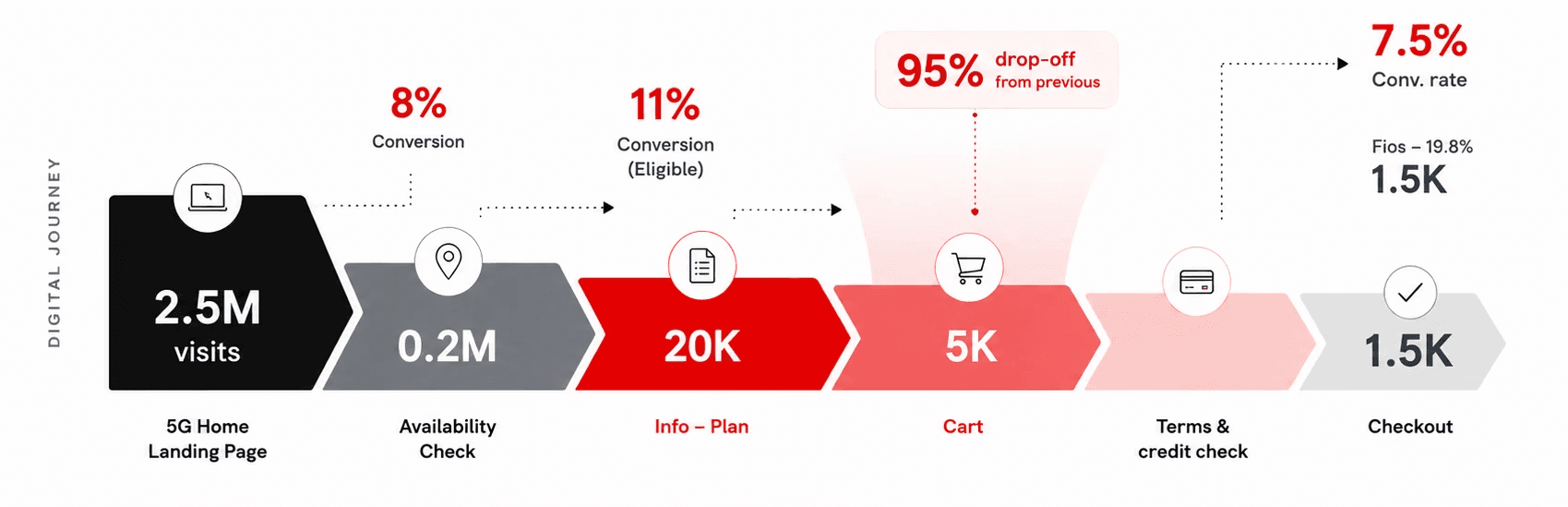
Massive Top-of-Funnel Drop-off
Up to 95% drop rate across early digital conversion steps (availability checks, plan matching, and initial qualification), leaving conversion rates in the single digits.
Over-Reliance on Call Centers
Up to 70% of total sales still occur through non-digital or assisted channels, with 25% of inbound calls focused purely on sales inquiries (plans, deals, pricing clarity).
High Post-Sale Care Burden
Human agents spent hours resolving highly repetitive, structured tasks like Fios return labels and simple bill checks.
Solution
Designing continuity across the entire journey
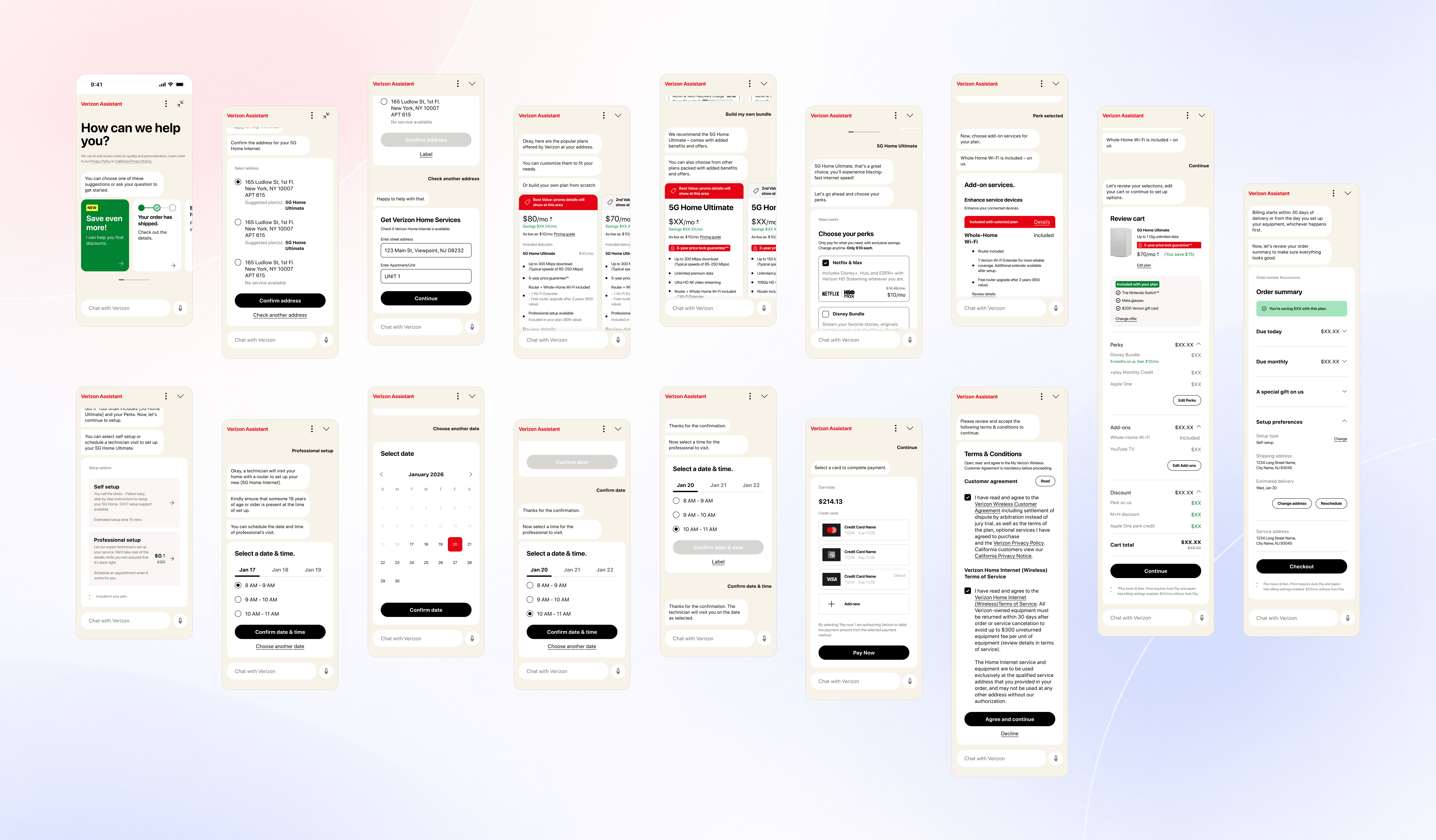
I mapped how intent, account context, recommendations, configuration, and transactional steps could work together across an end-to-end journey — taking users from initial discovery all the way through cart and checkout without losing context along the way.
HOW I got there
Approach
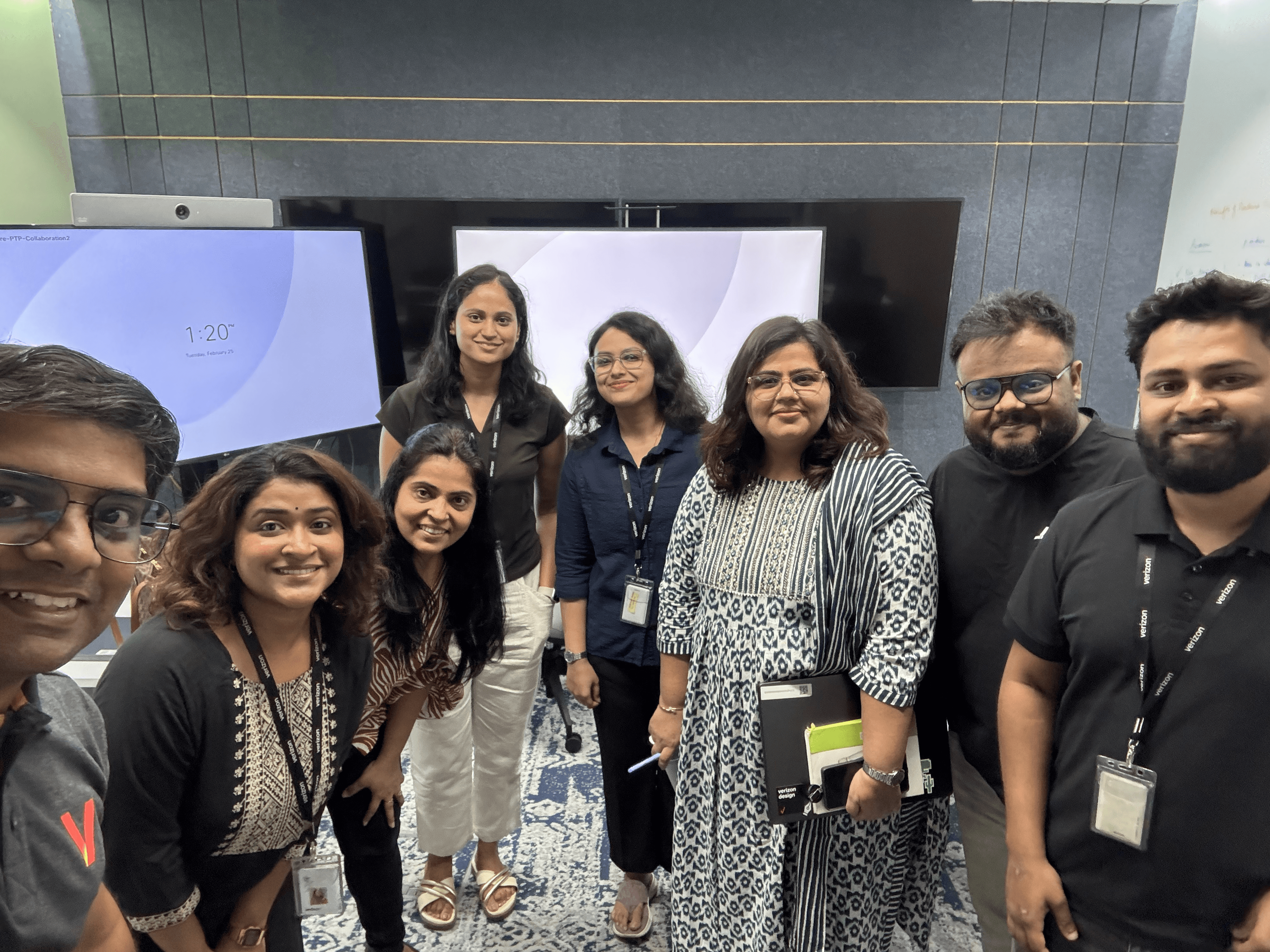
Given the complexity, scale and vested interests in the project, I approached it from a holistic as well as collaborative mind-set, whilst keeping the user at the core.




HOW i directed AI
From fragmented signals to design evidence.
I used NotebookLM to synthesize research, call-center logs, drop-off transcripts, and cross-functional workshop findings across 12 intent buckets, keeping insights grounded in source material.
Gemini helped me connect patterns across these inputs, challenge emerging hypotheses, and surface gaps worth investigating. I then validated the findings against the original evidence and translated them into journey problems, prioritized friction points, and opportunity areas that shaped the design direction.

Insights
Understanding our users
I identified four primary user groups to focus on, based on research, data analysis and cross-team collaboration.

Brainstorming
Turning evidence into design directions
I connected Gemini to my NotebookLM research base and used it as a grounded sparring partner turning evidence into design questions, exploring competing hypotheses, and challenging directions against research, edge cases, accessibility, trust, and product constraints.

Stress-testing ideas before designing screens
I created a custom Gemini Gem grounded in the same research to simulate how different user needs, intents, and contexts could change the journey. I used these flows to anticipate alternate paths, decision points, and edge cases before moving into detailed design.
Not the final flow → a hypothesis to design against.
I collaborated with Business to map out the actual user flow, considering the important journey conversion steps.


Design Direction
Turning possibilities into interaction patterns
I translated the strongest ideas into interaction patterns and end-to-end flows—exploring how the assistant could recommend, compare, clarify, recover, and respond across different user contexts.
Each direction was evaluated against clarity, accessibility, user control, business value, and feasibility before being taken forward.
What I would do differently today: With the design system in the front end, I'd use Figma MCP and Claude Code to generate V1 designs directly.

What I Specifically Did
Framework Optimization
After leading a cross-functional workshop and auditing the live flow, I designed a five-step structure that replaced the one-size-fits-all menu.





proposal
Secured Alignment from Partners
The biggest challenge was aligning business, product, and engineering around a new direction.
Some UI elements that research identified as low-value were considered critical by partner teams. Instead of debating individual components, I reframed the conversation around user goals and demonstrated how the redesigned flow could better support both customer needs and business outcomes.
By visualizing the future experience through iterative prototypes, we reached alignment and unblocked the project.
Methods: Low-fidelity wireframes · High-fidelity prototypes · Cross-functional design critiques


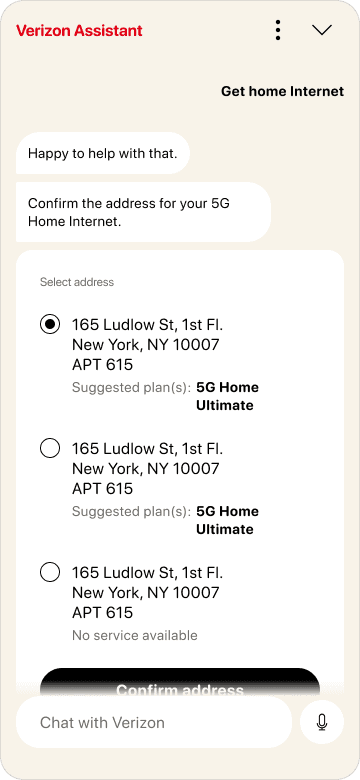
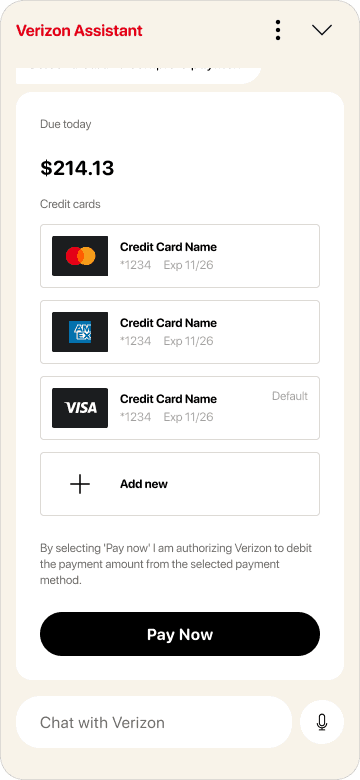

Highlights
3 rounds of presentations and multiple iterations.
Outcome
Key partners aligned,
Extended partners directionally aligned,
Shared partner goals.
Learnings
It is key to convey potential opportunities by creating a scalable UX framework and advocating to users all through-out.
going live
Dev Handover & Production Release
We launched the redesigned conversational experience across the My Verizon App and Verizon.com, replacing fragmented, predefined support journeys with a more unified and guided conversational experience built to scale across customer intents.

Outcome
Shipped a Context-Aware AI Assistant at Scale
We successfully deployed the baseline conversational engine across both the Verizon App and Dotcom ecosystems, replacing thousands of static FAQ pages with interactive, guided
Metrics represent project outcomes shared by stakeholders and are presented at a high level due to confidentiality.
Continuously Enhancing Chatbot Journeys Through Research
We use a continuous cycle of data analysis, customer feedback, and usability testing to identify friction points and optimize every step of the chatbot experience.
